
Intro
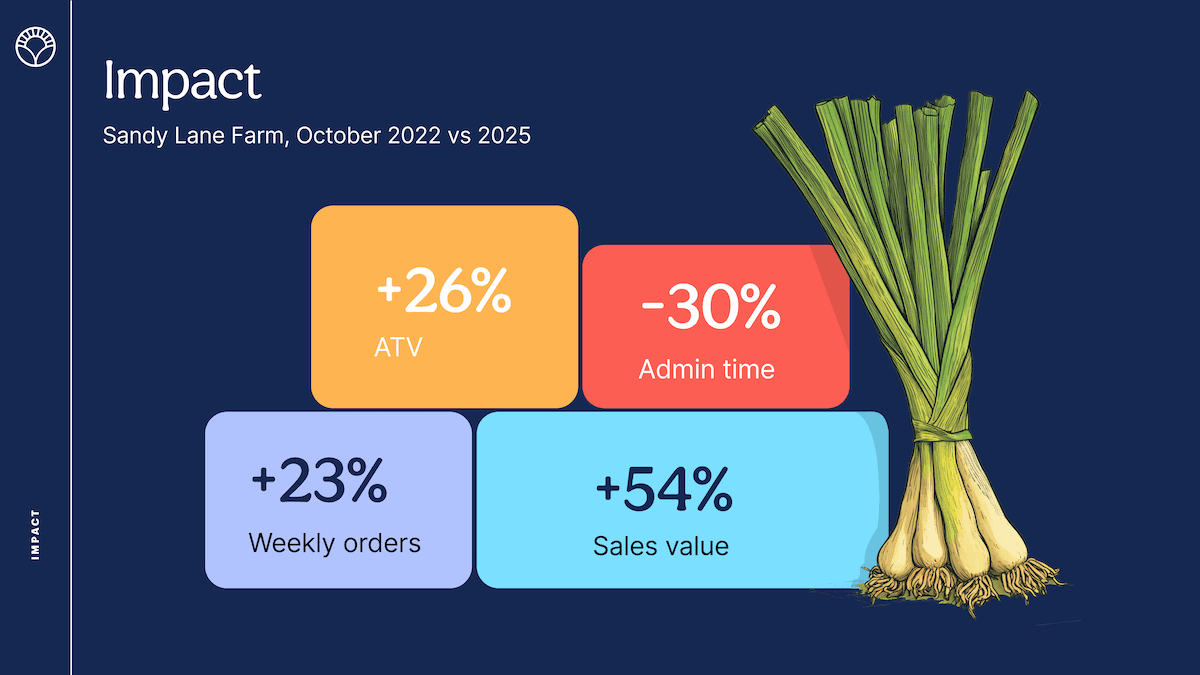
Since partnering with Growing Good Technology, Sandy Lane Farm has seen online sales soar by 54% in just three years — all without a marketing budget. In fact, at the time of writing (Feb '25), weekly sales are now consistently around 75% up.
By optimising their online store, utilising inventory management and other products controls available in Growing Good, George has given his customers greater choice and convenience, without risking waste or overwhelming complexity in the packing shed. Customers have spent more and stayed longer.
Impact
In the 36 months since moving to our platform Sandy Lane have delivered a significant increase in both average basket spend (£21.35 to £26.90) and weekly order numbers. This balanced growth has been consistent and manageable, and with careful planning, delivery van capacities have improved, delivery densities have increased and ‘cost per drop’ fallen - this has resulted in greater margins, both in relative % and absolute terms.
Building Blocks of Sandy Lane's Online Success
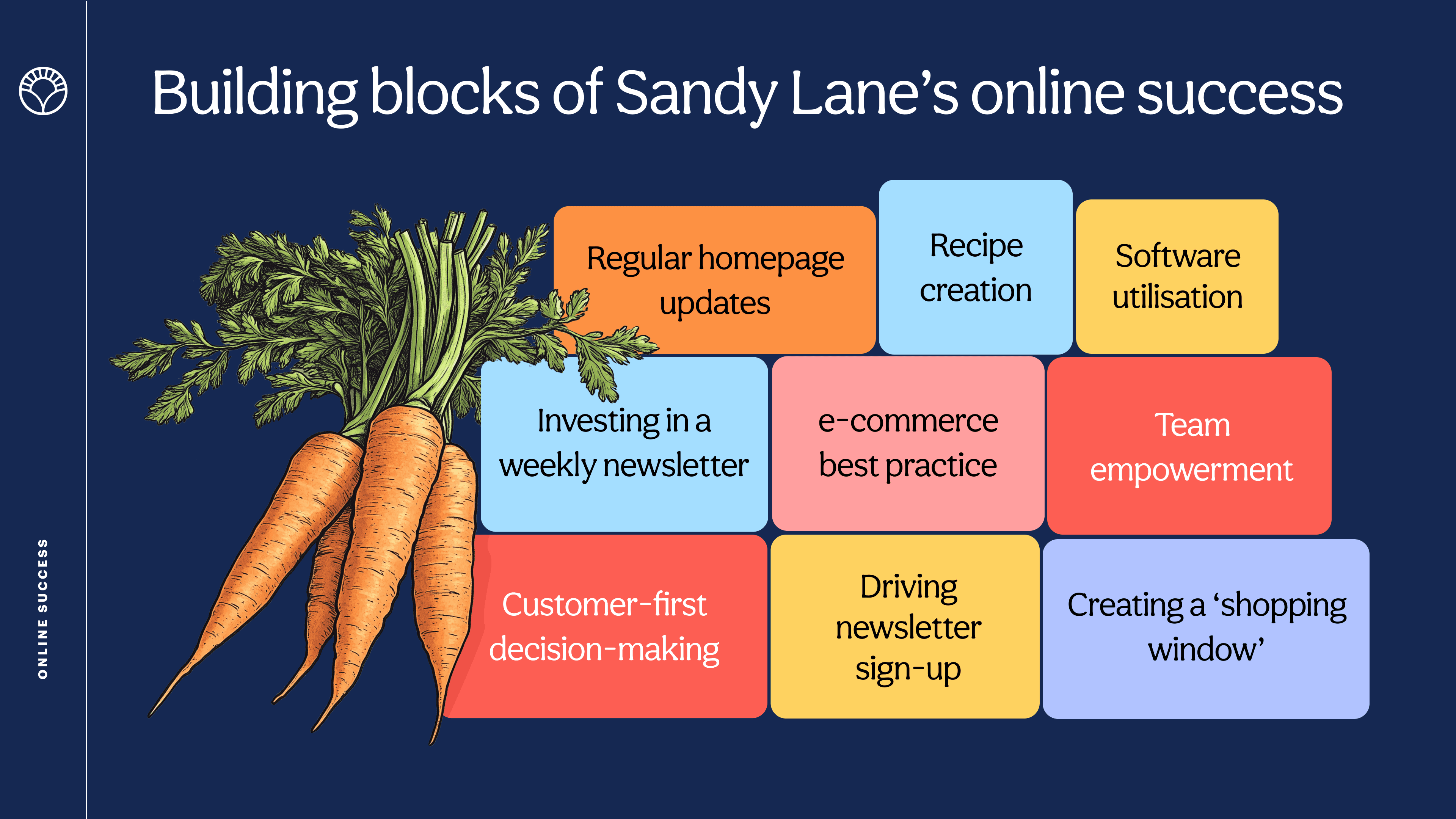
We’re going to take a more detailed look at some of the building blocks visualised here. Not everything here will be 100% relevant to every box scheme out there; see this is as a ‘pick-your-own’ menu of options, please don’t feel overwhelmed by thinking you need to invest in all these areas at once. As at Sandy Lane, it’s a story of progress not perfection, with much remaining to be done.
Creating a shopping window
Like the majority of box schemes, Sandy Lane Farm have x1 order deadline per week - in their case, a Tuesday night. Although this simplifies things vs box schemes with multiple - the principles described here remain.
Delivery days have been long established as a Thursday and Friday, with almost all box packing taking place on a Wednesday.
With this cycle in mind, they set about establishing a ‘shopping window’ - a time in the week where shopping/subscription management activity is encouraged. In their case, this is Monday & Tuesday.
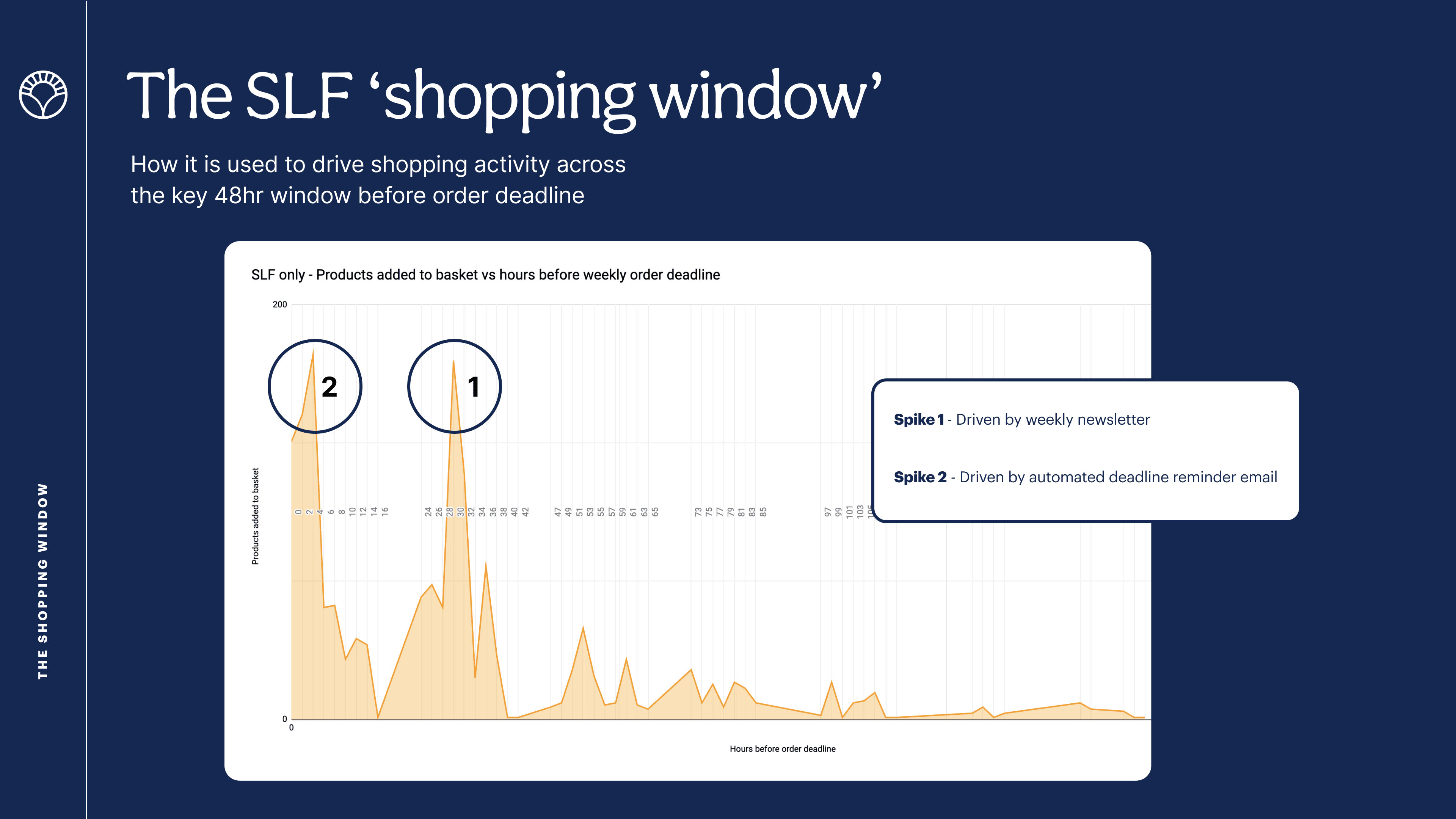
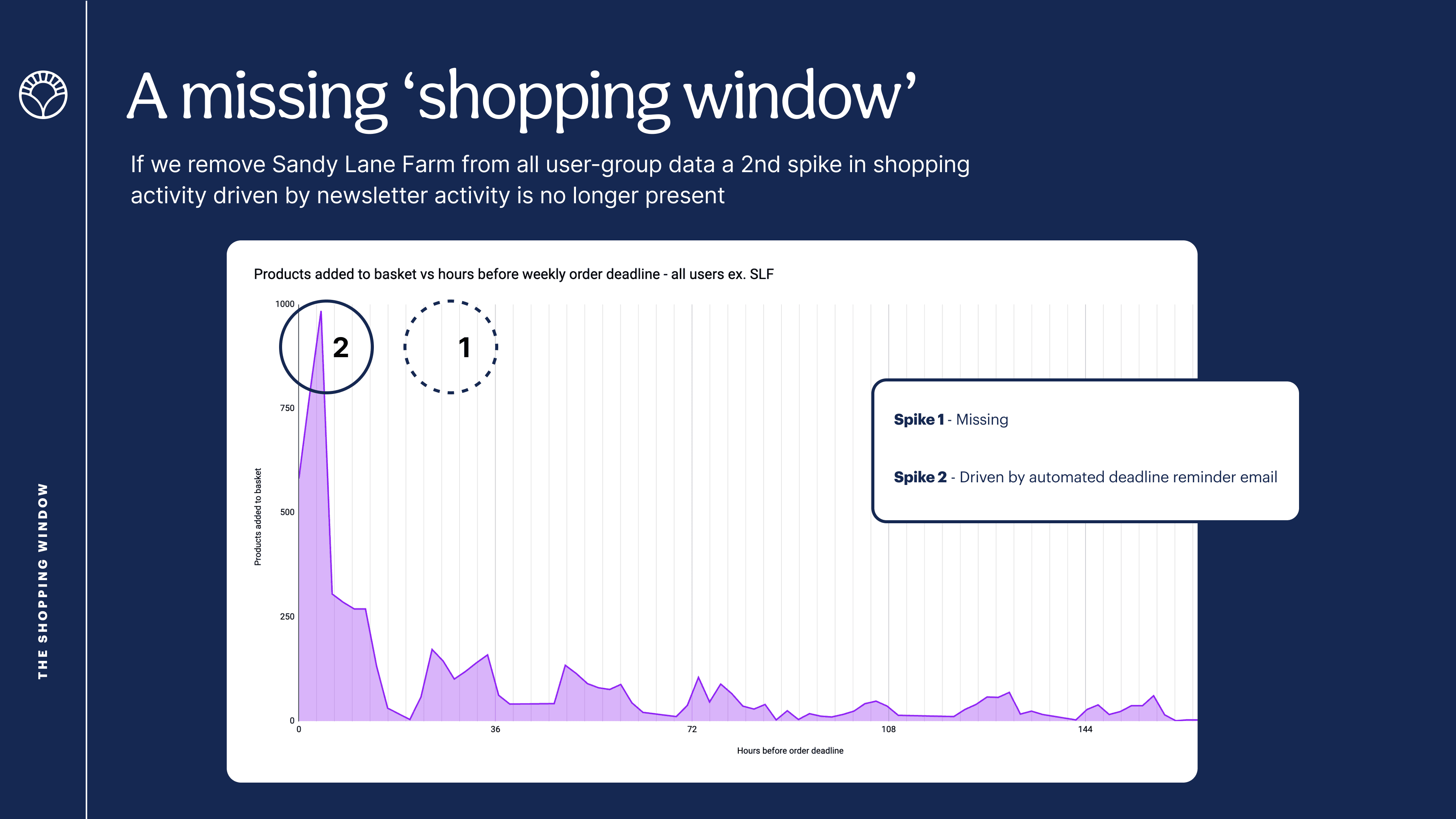
The above visual shows `products added to basket` vs the `time to deadline` - simply put, when customers are shopping vs how long left they have to make changes to their order. We can see 2 clear spikes in activity;
- 28-32hrs before the deadline. This is driven by the weekly newsletter that George & Cate send on a Monday afternoon (more detail on that below, plus some valuable insights from Emma Treanor, who curates the content for it).
- 0-5hrs before the deadline. Driven by the automated deadline reminder email sent by the GG system at 5pm on a Tuesday.
The timing and content of these weekly emails are vital. As you will see from the detail to follow, the weekly newsletter is informative and personal - it does a great job of ‘connecting’ customers with the farm. The automated reminder email sent 4-5hrs before the deadline is basic and transactional - it says “this is what you’ll be getting and how much you’ll pay unless you decide to take action.” It’s a ‘now or never’ message, whereas the Monday newsletter is more warm and gentle with the ‘nudge to shop’. These 2 distinct type of comms appeal to customers differently depending on the way their brain works - many of us ALWAYS leave things until the last minute, some of us like to take our time, engage with information and plan ahead. By having both in place, we cover all bases, every week.
Minimising the time between deadline and delivery
As the volume of product sold has grown, George recently decided to increase his delivery capacity by introducing a new Weds afternoon delivery round. One of his regular drivers has taken on an extra day, helping pack boxes in the morning, and delivering local to the farm in the afternoon. It is not without challenges, but excitingly for us it is evidence that ‘next day delivery’ is indeed possible.
There is strong evidence from across e-commerce that ‘next day’ (and now even ‘same day’) delivery is a big driver of online sales - it’s what Amazon have built their business around. These benefits also apply to us - although our challenge to fulfil this service is far more complex than just how to move product. We fully appreciate that needing to place wholesale orders on Tuesday of week 1, for product coupled to an order deadline of Tuesday in week 2 (without other sales channels to help avoid wastage), is a tall order. We are mindful of this and are growing our knowledge further up the supply chain to help reduce the challenge for you in future.
Speed and convenience have impact
Sandy Lane Farm allow customers to look into their fridge / cupboards just 24-72hrs before their next delivery to influence how to shop. This, coupled with being able to swap items in and out veg boxes results in a very different feel to the shopping experience - it also encourages the ‘while I’m here I’ll grab one of those as well’ purchasing that really helps to drive up basket spend.
Removing Sandy Lane Farm from our data
The significance of the SLF weekly newsletter becomes very clear. Below we see a chart with the same data as before, for all platform users other than SLF. There is a clear spike in shopping activity 0-5hrs out from deadline, driven by our automated deadline reminder email, but no similar spike the day before as we see with SLF. Our understanding is that some of our community send newsletters weekly but many are less frequent, with some in the ‘not at all’ category.
E-commerce best practice
First a caveat: ‘Best practice’ is the term used but we’re currently in the early stages of collecting enough data and testing to validate what we believe ‘veg-commerce best practice’ to really be. You’ll be kept informed of our progress!
Here we’ll look at two examples of how George is being proactive to improve the online shopping experience and increase average basket spend.
Making popular add-ons easy
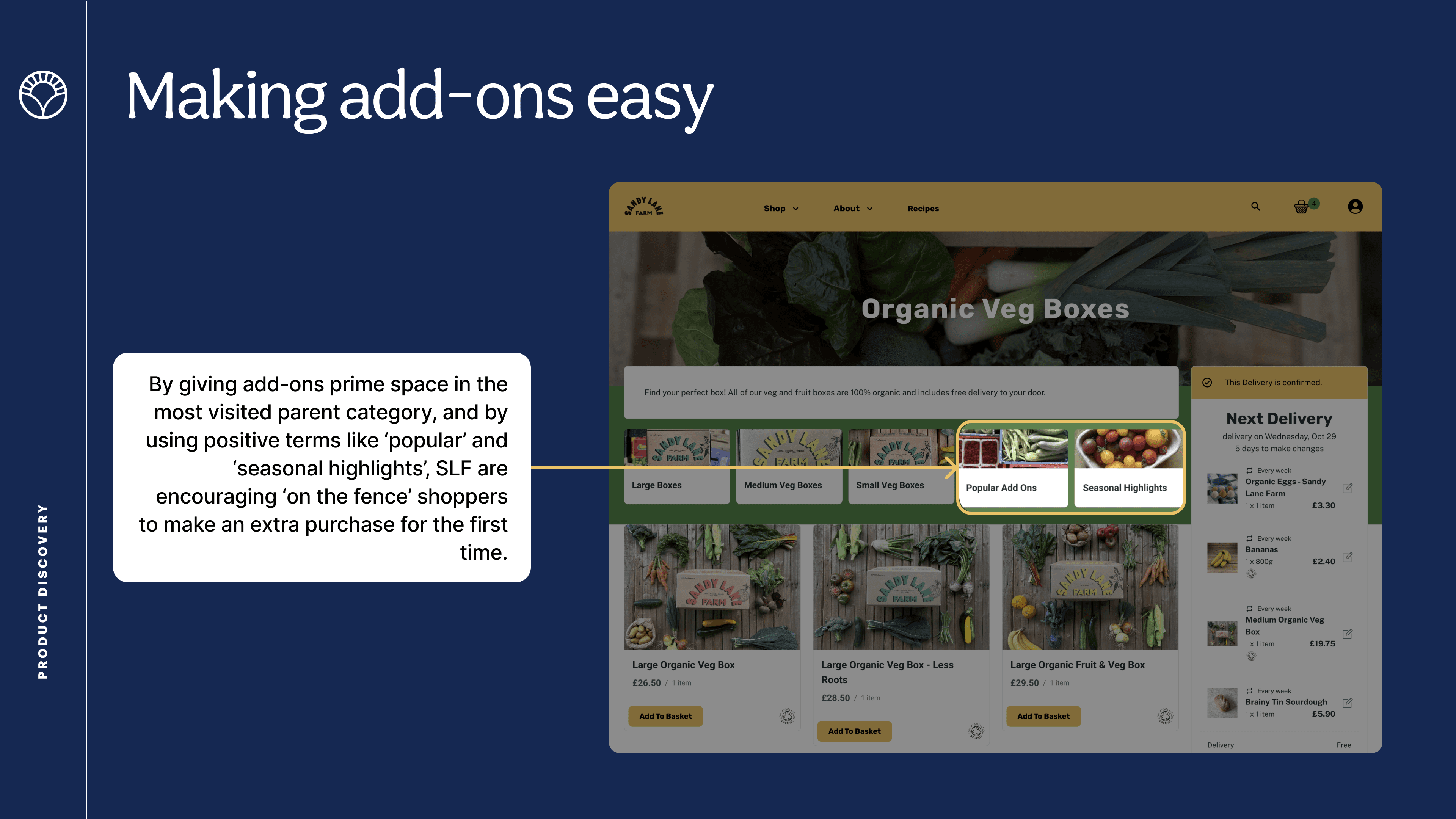
Here we can see how George is using sub-categories to showcase add-ons. Using terms like “Popular” and “Seasonal Highlights” stimulates curiosity - even if the buying-intent isn’t there many customers are likely to ‘have a nosey’ and look at what others are buying, or what they might be ‘missing out’ on.
These sub categories also appear as filters in search results helping to increase visibility further, and allow George to include non-veg items from less frequently visited categories (his ‘popular add-ons’ currently includes washing-up liquid refills, butter and honey - highlighting the range of products available in the store).
Using the homepage effectively
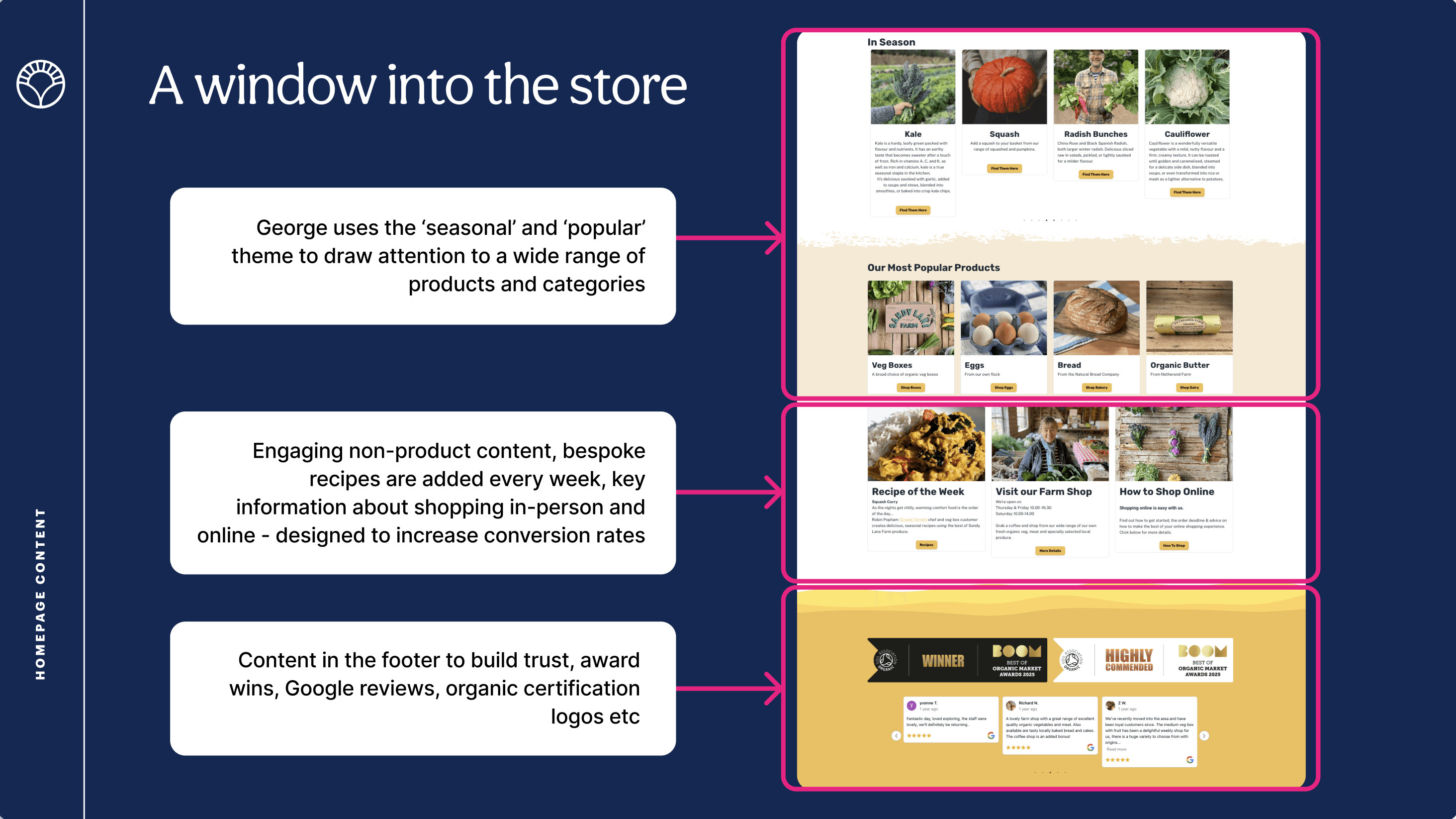
George spends a small amount of time every week updating his homepage - the key landing page for both returning and new customers. The visual here is taken from below the main banner (the ‘hero’ banner). George uses the homepage to offer a window into his shop - helping guide visitors to content they are most likely interested in, which hopefully leads to them spending more time on the site and money!
It's design that:
- Draws attention to products - “here’s what we’re great at, come and buy some.”
- Informs and engages - new recipes give a reason to return every week, information about how to shop with SLF helps to inform and reassure new customers, increasing conversion rates.
- Accreditations, reviews, awards - helps to build trust with new and recently-new customers.
Recipes for success
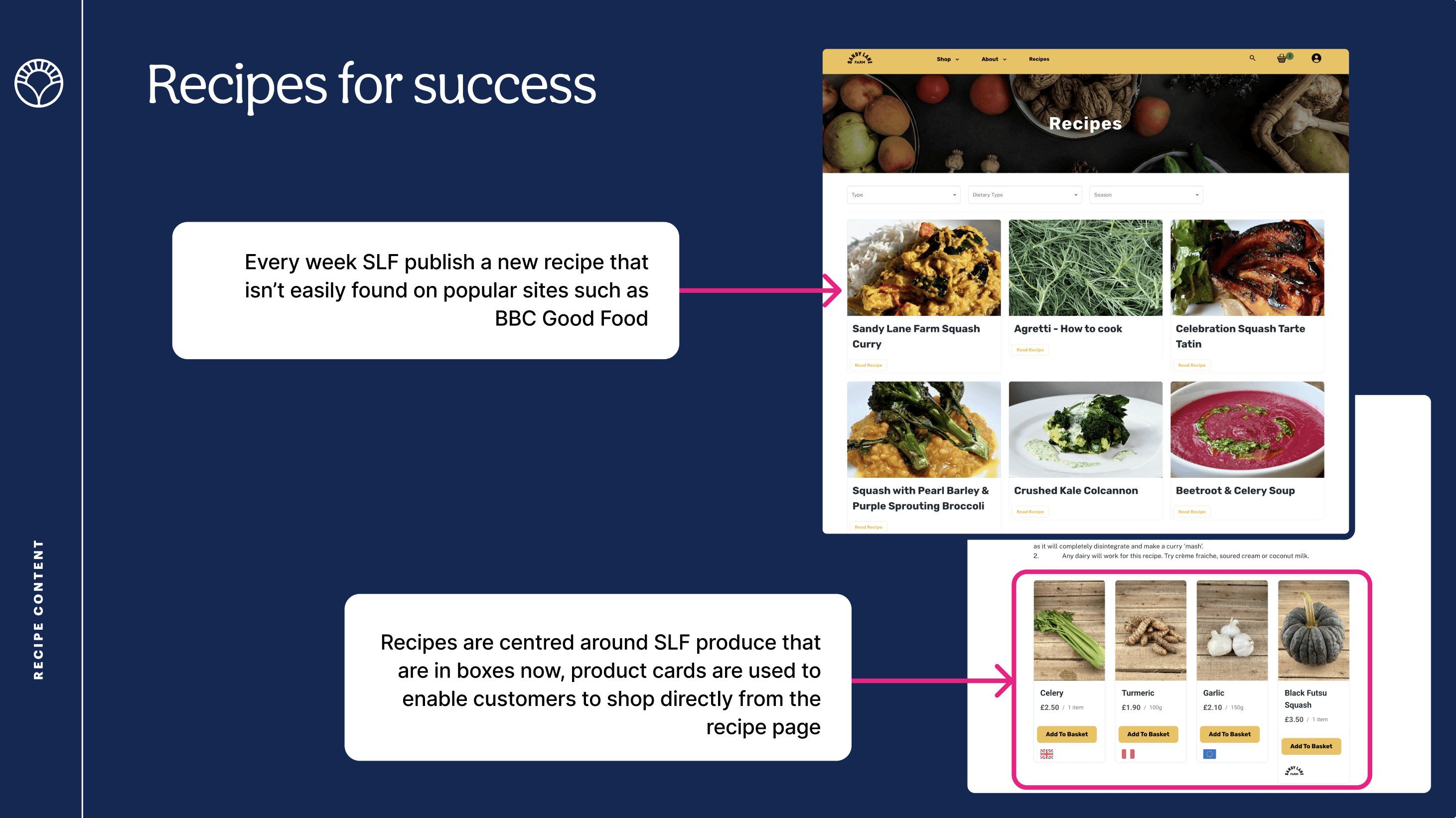
George & Cate partner with a talented local chef (also a veg box customer) who curates a new recipe each week, centred around produce that can be found in this week’s veg boxes.
These recipes are shared via the newsletter and the website homepage, this joined-up approach pays huge dividends as visitor numbers have soared beyond expectations.
George adds product cards at the bottom of each recipe so customers can add any required items available in the store directly to their basket. Nice thinking George!
Worldwide fame
Some recipes have really taken-off and are providing us with valuable intel to help understand how we can harness the engagement they create more effectively within the Growing Good ecosystem.
The simple recipe highlighted below ‘Gem Squash - How to cook’ has received huge traffic (relative to the world of local veg boxes) from 55 different countries. It’s a national favourite in South Africa which explains why 50% of hits have come from there. While not directly helpful to selling veg boxes in Oxfordshire, the understanding we are building identifies some exciting opportunities for us that will have benefit much closer to home!
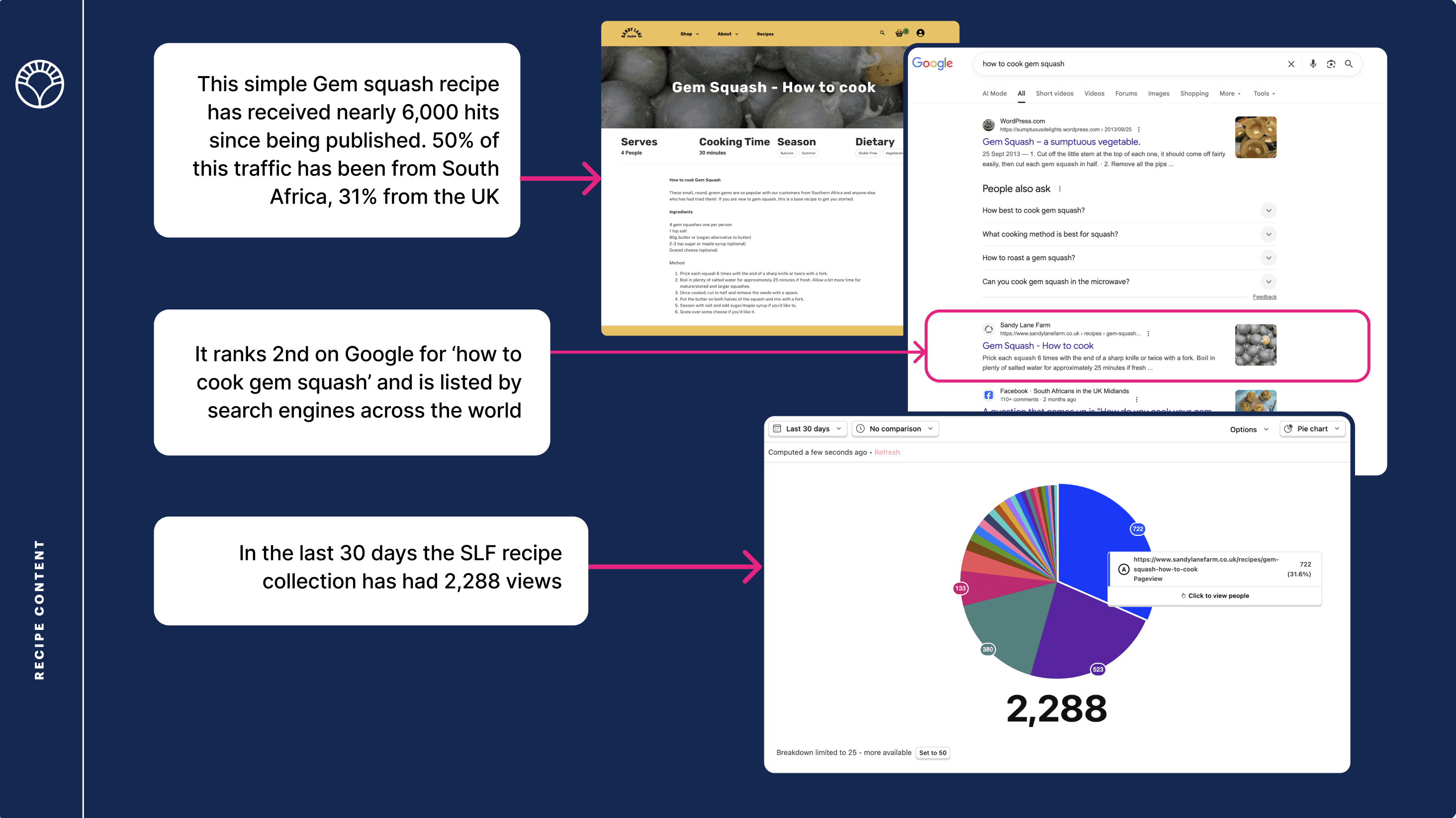
More to come from us on how we can utilise the potential for veg-box centric recipes across our community. In the very short term, if you have the bandwidth to begin building your own library, we would strongly recommend it.
Newsletter activity
We have seen how valuable this newsletter is - significantly driving shopping activity every week on the SLF store. BUT… investing in a weekly newsletter requires an audience to have impact, so we need to make sure visitors to your store (especially those that haven’t shopped before) are encouraged and can easily sign-up.
Below you can see how big and obvious we made the sign-up block on the SLF store. Being honest, it’s arguably not e-commerce best practice to give-up such a big chunk of prime real-estate that should probably go to products. However - we wanted to measure the difference it may have.
On September 16th we introduced the block with the idea of;
- It being BIG, loud and unmissable
- It sounding GREAT - informational as well as salesy, “if they’re giving it a prime spot on the website the newsletter must be good?”
- It capturing ‘on the fence’ potential new customers - increasing the size of audience in the SLF ‘conversion funnel’
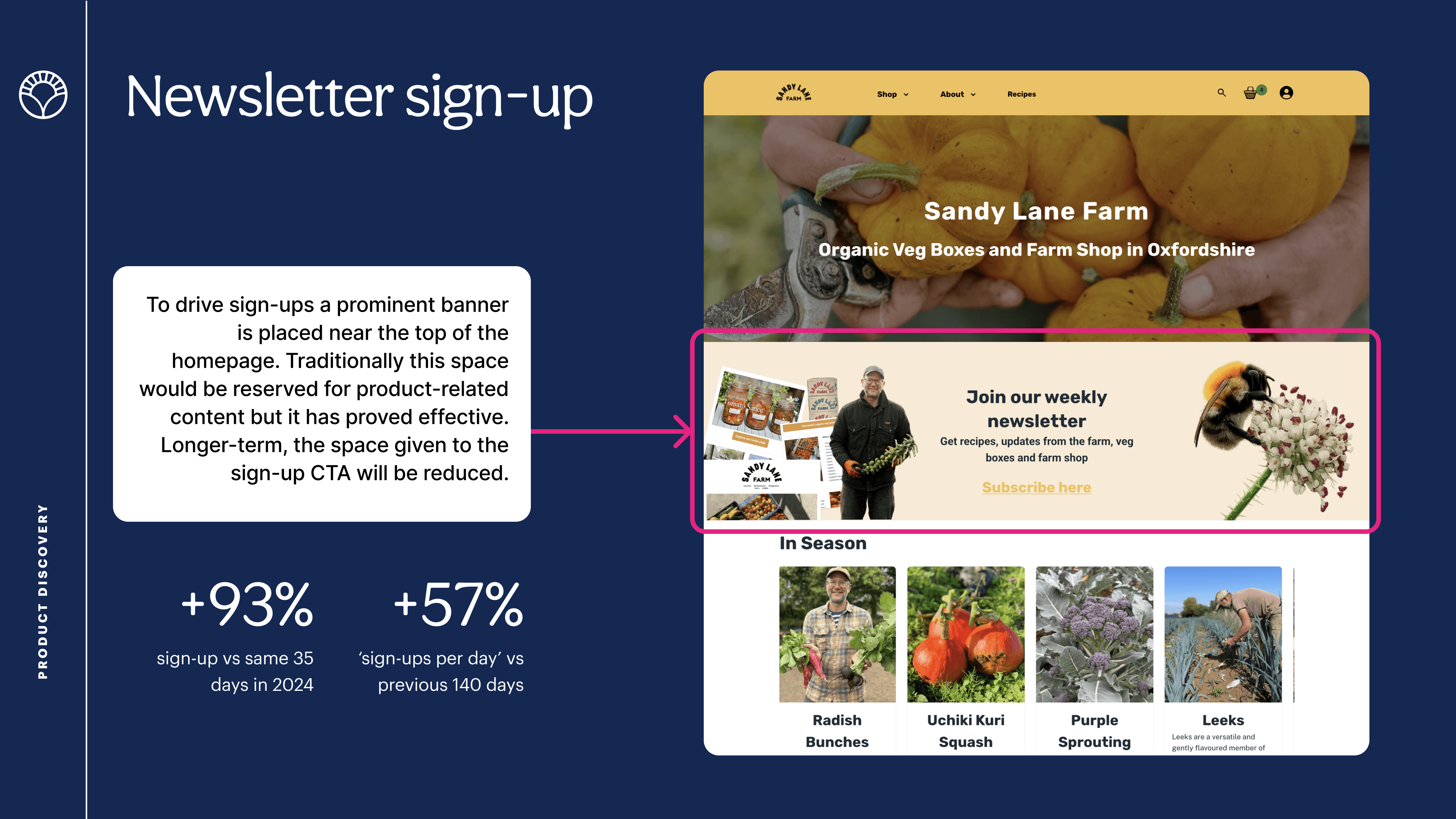
Compared to the same 35 days in 2024 sign-up rates increased by 93%, vs the previous 140 days ‘sign-ups per day’ increased by 57%. Our conclusion - the placement and design has had significant and positive impact.
In September Sandy Lane welcomed 52 customers placing their first order - a best ever month, despite £0 increase in advertising spend. Since the school Summer holidays SLF have enjoyed 6 ‘best ever’ sales weeks (outside of Christmas week), between 25-30% up on 2024 alone.
A watch-out: Please don’t replicate the size and prominence of SLF’s newsletter sign-up block unless you plan to send regular mailers, otherwise that space is much better served with product-related content.
What’s in the newsletter?
It’s what you’re probably most interested in. I have broken down the format of content below and written explainers on the value of each, plus shared some really great insight from Emma, who has been curating the SLF email for a number of years now.
You can check out the full archive of SLF newsletters by clicking this link.
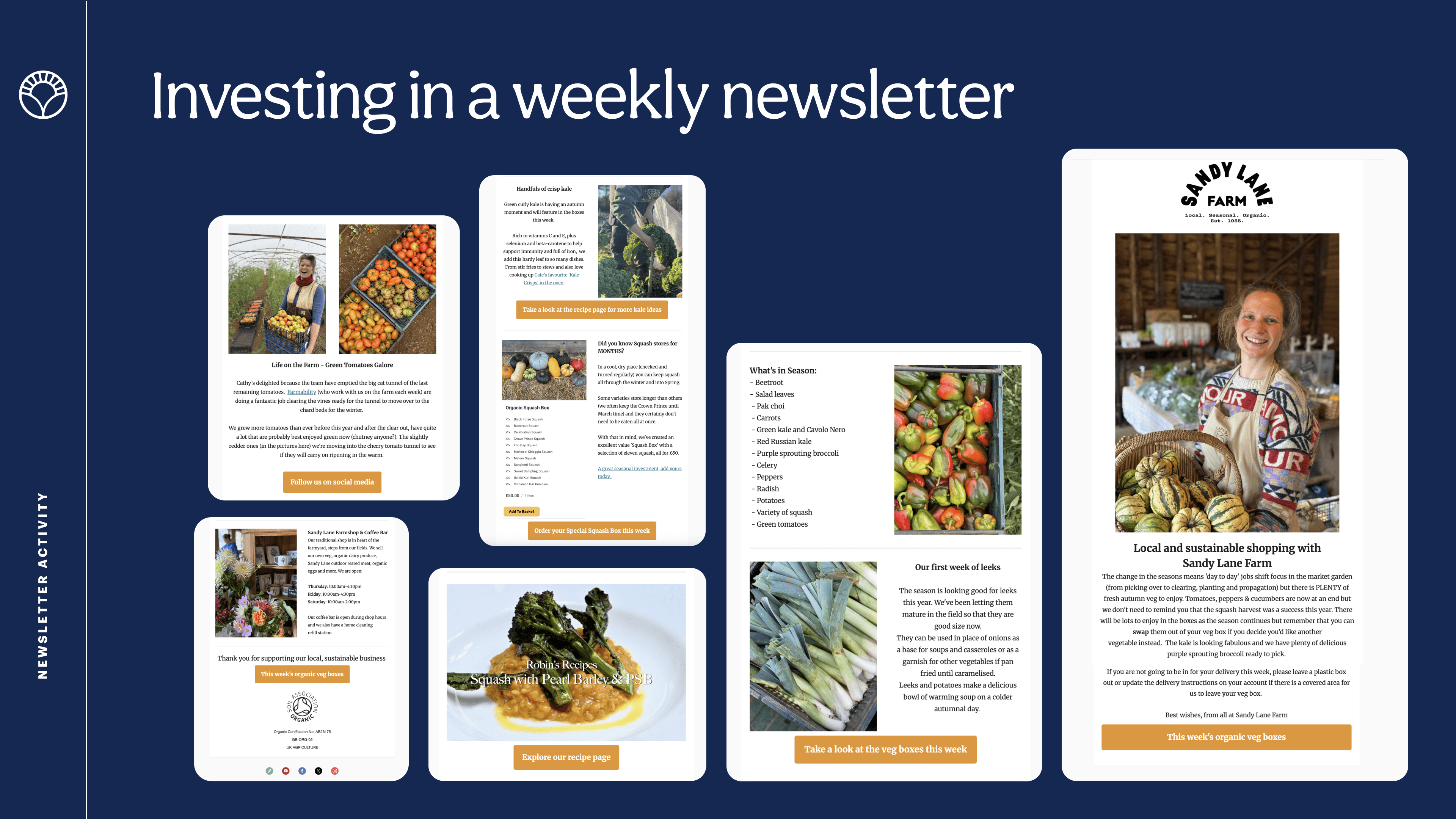
The recipe for success
It has taken a number of years to refine the format of Sandy Lane’s weekly mailer, we might save you some time by sharing the learning. This is our interpretation of what has worked well;
High quality pictures
You can’t pick up items, see the produce or meet the people when you’re shopping online - having good quality pictures helps make up for it.
Use the right pictures - as camera shy as you may be, customers love seeing the people behind their food, warts and all! Invest in the time to take them regularly, try not to recycle the same 3 pictures that you took 5yrs ago if at all possible. Use lots of product shots - being picked, ready to be packed, in boxes - helps tell the story of how a bag kale arrived in their kitchen.
Recipe pictures need to be well-lit and look appealing.
Some snappy lead content
A quick summary combining an update from the farm, a focus on product, a reminder that you can swap items in the box (deals with one of the most common barriers to shopping) and a clear call to action ‘click here to shop veg boxes’.
Showcase your produce and link it to the season
You’re hoping to drive product sales so invest the time to help explain why today is literally the best day to buy seasonal veg!
Use recipes to your advantage
There’s a fine line between celebrating the season and customers wondering what to do with their kale or squash for the 11th week in a row! Help mitigate any seasonal fatigue with recipes - in the newsletter pictured above there’s a spotlight on kale, linking it to the season, highlighting its healthy properties and a link to a recipe idea (in addition to the ‘recipe of the week’). It’s a full-house of positive vibes for an item that has been a boxed-regular for a number of weeks now.
Life on the farm / in the packing shed
Share an update involving your farm or business to make a personal connection. In the newsletter above Sandy Lane have talked about their partnership with a charity (farmability) and coupled it with a call to action button linking to their instagram account.
A social media CTA
Encouraging newsletter subscribers to follow you on social channels is an obvious win. A joined-up approach to the newsletter and social media content creation returns more value from your time (or budget), killing 2 or more birds with 1 stone. Sorry birds.
Recipe of the week
Each week a new and original recipe is shared using seasonal SLF produce available to shop that week. More on the use of recipes has been covered above.
Regular housekeeping
For SLF, that’s a regular reminder to visit their farm shop and coffee bar, with opening hours.
Newsletter insights from a pro
Emma Treanor has been working closely with George and Cate, ‘telling the Sandy Lane story’ by creating content for their socials and newsletter over a number of years now. Completely independently of my breakdown above I asked her to share in her mind, what makes for an engaging newsletter.
Here’s her reply:
Hmmm, it’s hard to know what is effective when it comes to the newsletter, it’s an inexact science! But in my opinion:
- A lot of good photos. Attention grabbing, action shots, farmers smiling with the harvest. Colour & life. Not just snaps of the veg. Include action and life. Adding the personal to the product.
- Make sure you have a photo for everything you are talking about. Eg: make sure you have a pic of tomatillos for the week when those feature. Maybe on the plant to add interest.
- Recipes. The ones from Robin have been amazing. We’re lucky to have him. Also, now we’ve got a stash we can re-use old ones. Building up a recipe library has been important.
- Clickable tabs/buttons. People like those. Early on & at the end of the mailer in particular so people know where they are each week.
- Clickable links within the text. A surprising number of people use these.
gentle reminders to order are crucial but don’t make the whole mailer about sales.
- People switch off to simple ‘selling’ in my opinion and are less likely to read the rest. Pepper the links and sales stuff in amongst the chat.
- Make the layout familiar but change up the imagery and subject matter. I always change every pic each week, even if I’m talking about the same thing.
- Some colour is good and play around with nice fonts (but not my forte).
- Make it friendly and not a moan. No one wants to read about farmers moaning!
Regular reminders of what they are buying & why - the local, seasonal, organic messaging. But gently.
Hope that helps!
---
Well done for making it this far! As you may have noticed we have only covered some of the building blocks identified earlier. That leaves us with new areas to cover in the future and more data and insights to share regarding some of the above.
If you have any questions or views, or would be interested in joining a webinar for us to discuss in more detail, please drop me a note via steve@growing-good.co.uk
Steve and all the team at Growing Good.
Immediate impact
Here's one from the early days - a short video looking back at the first 12 months for Sandy Lane Farm on our platform.