
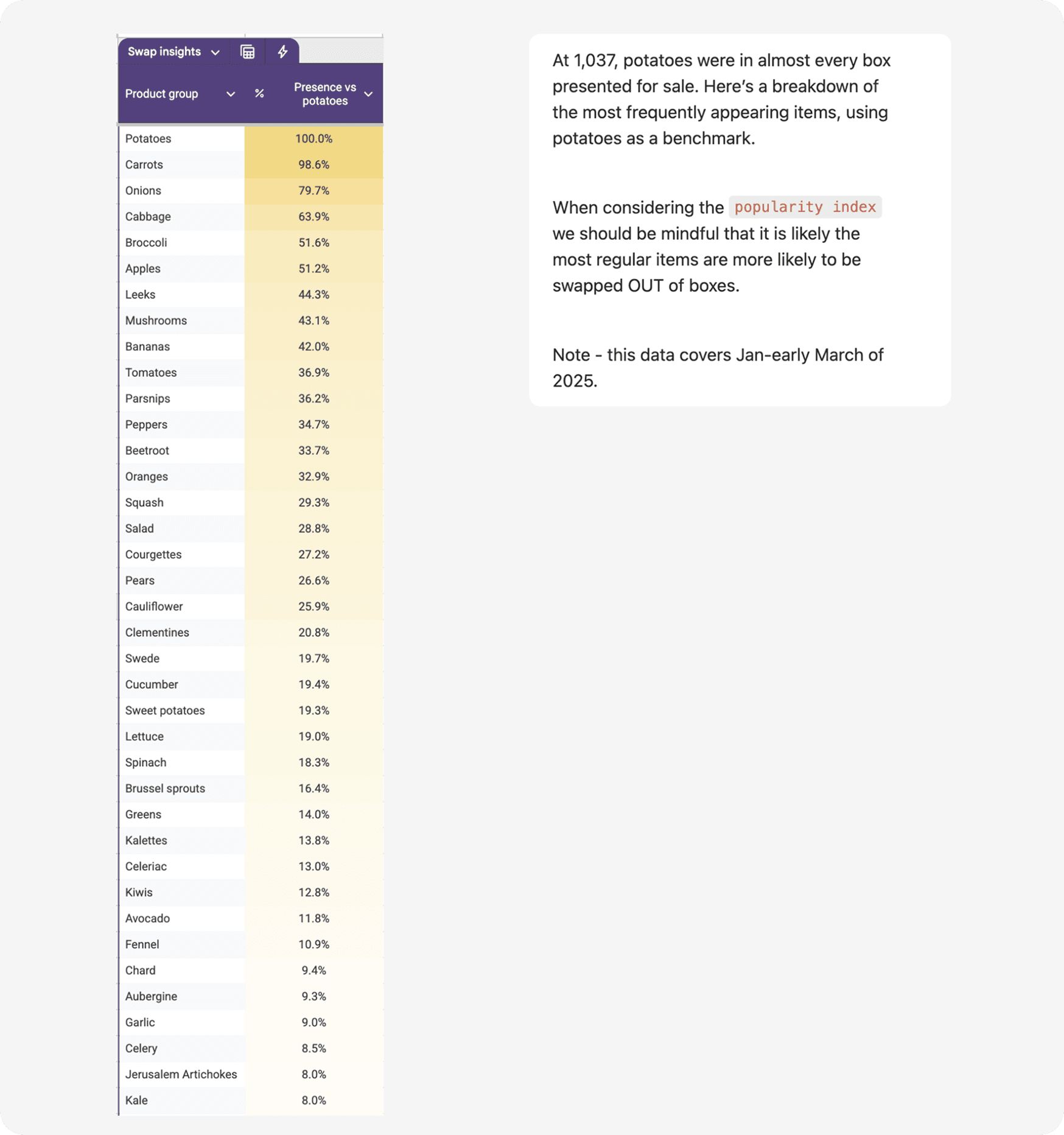
“Let them eat turnips” was the message from the Tory Environment Secretary around this time of year in 2023. Well, since only 8% of veg boxes sold on Growing Good so far in 2025 contained turnips, now wonder the public didn’t like it much.
We have analysed more than 50,000 veg box swaps made so far in 2025 and are excited to share the insights with you. We are beginning to build a picture (well, more a data model) that will help understand customer preference and forecast future demand.
The cohort of data we have analysed is across the Growing Good community for weeks 01-11 of 2025, and only for veg boxes with customer swaps `enabled`. While this excludes some boxes and some veg box schemes entirely, we think the data is valuable to all as it offers a window into customer preference at scale, possibly for the first time in the UK market.

Headlines
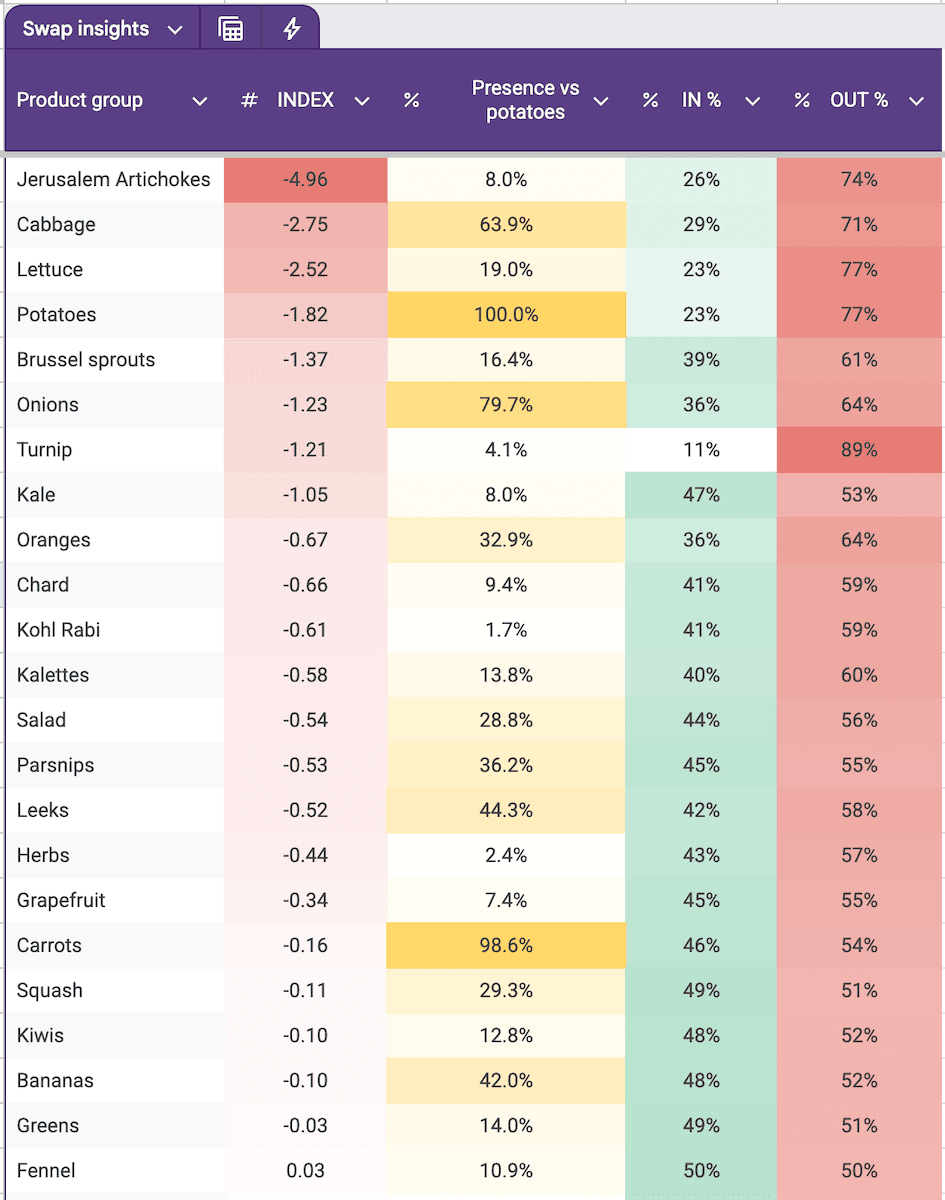
We have calculated a `popularity index` that takes into consideration the frequency an item was planned into a box and the ratio of it being swapped OUT vs swapped IN. The chart below visualises this, with the items most frequently swapped out (in proportion to the number of times they appear) at the top.

Notable take-outs
Despite only being planned into 8% of boxes, **Jerusalem artichokes** take home the prize of least ‘popular’ item - they appeared in boxes 83 times and were swapped OUT by 639 customers. That’s 7.7x for every time they appeared in a box. They were swapped IN 2.73x per appearance (most likely to be in weeks they were not in boxes), giving them an `popularity index` of -4.96.
It’s a busy time of year for **Cabbages**, they were in 64% of boxes and were the most swapped item, 4,346 times [3,084 times OUT + 1,262 times IN]. There are many varieties wrapped under ‘cabbage’ - next on our list is to analyse how preference changes between varieties, how many customers are swapping out savoy because a pointed cabbage is available? We will report back!
**Beetroot** has a net positive index of 0.80, being swapped IN slightly more often than it is swapped OUT. Context - it only appeared in 34% of box contents and has one of the highest `activity ratio`’s, meaning it was more likely to be swapped IN or OUT vs how often it appeared in boxes.
We were surprised to see **salad leaves** swapped OUT more than they were swapped IN, despite being in only 29% of boxes. **Lettuce** (categorised separately from salad leaves) also saw a negative index, despite only being in 19% of boxes.
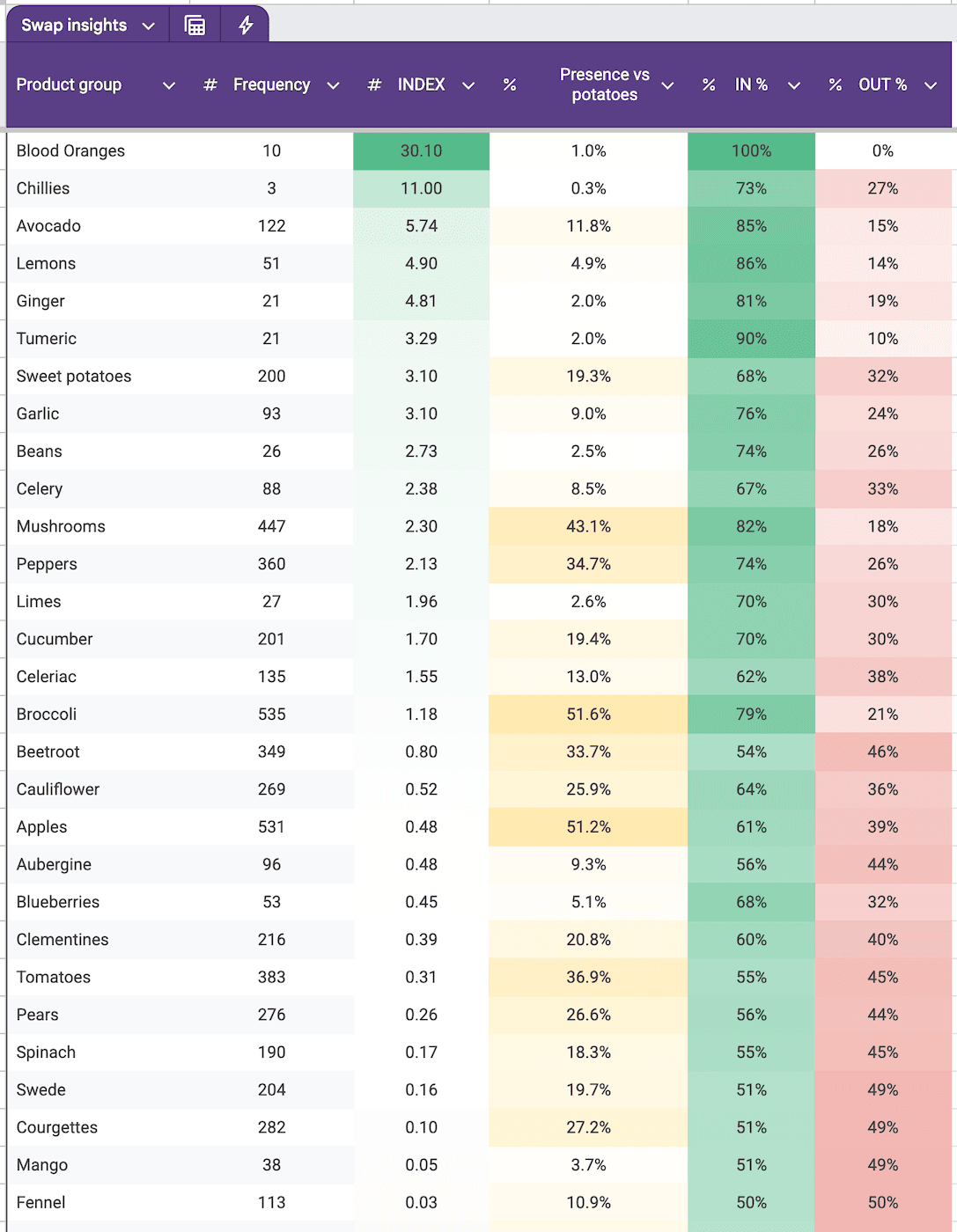
**Mushrooms** are a stand-out item with a positive index of +2.30, in 43% of boxes but still swapped IN significantly (involved in 1,632 swaps, 82% of which were IN). For more detail on mushroom swap activity at Sandy Lane Farm including commentary from George, please see the bottom of the page.
**Sweet potatoes** were similar to mushrooms, although more frequently swapped OUT - while very popular overall, given they are likely to be grown further afield, could some customers be **saying no to higher food miles**? Maybe not if we consider the next point…
Items less likely to be in a box such as **avocado**, **lemons**, **ginger**, **turmeric** etc were all very ‘popular’ but in lower overall volume. **Avocado** in particular was swapped into boxes very frequently when available.
Which items appeared most frequently?
The least ‘popular’ items
Note - we must take how often items appear in box contents at this time of year into consideration (the more often, the more likely they could be swapped out).
The most ‘popular’ items
Items with a positive index. Note - the lower the `frequency`, the lower the confidence we have in the ranking. Eg. I would recommend disregarding blood oranges and chillies from any conclusions drawn.
Summary
We are already investigating some of these numbers in much greater detail - we realise there are many reasons why an item may be swapped IN or OUT of a veg box and there are lots of pro’s and con’s of every decision you make to include or exclude items. We are absolutely not saying that one item is *good* and one is *bad*.
The data we have shared allows us to identify patterns and investigate the reason behind them, i.e.
> “If I have put **broccoli** in my boxes in 4 out of the last 6 weeks, how much more likely is it to be swapped out next week?”
> “I know **Avocado** is a very popular swap IN, would only making it available as an `add-on` increase my basket spend, or could it cost me customer satisfaction and longer-term retention?”
> “I seem to be running out of stock of mushrooms before the order deadline each week, why are they so popular at this time of year?” [see below for more data on this]
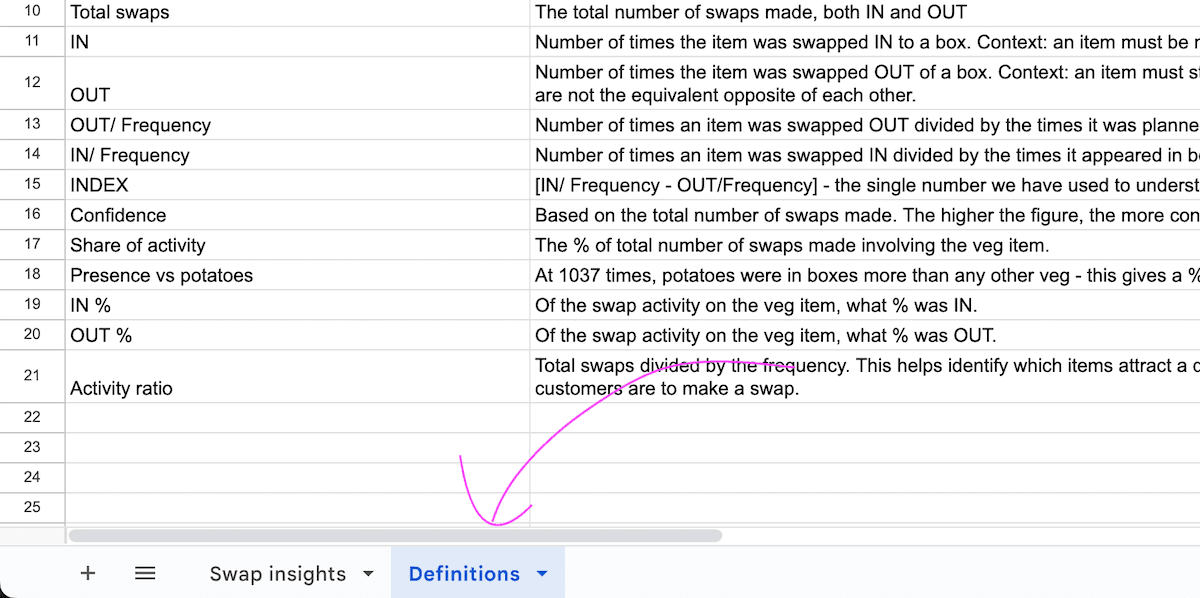
You can access the full data table here: Link to Google sheets
More on mushrooms at Sandy Lane Farm
In the first 11 weeks of 2025 mushrooms have appeared in around 50% of George’s veg boxes. Despite this, they have been swapped IN 390 times and only swapped OUT 55 times. They *seem* very ‘popular’.
Here’s a window into George’s recent mushroom-related experience;
We have three main outlets, veg boxes, farm shop and a farmers market – and they are in that order sequentially in the week.
Since the new year, we have consistently run out of mushrooms, certainly by the time the farmers market comes along, and sometimes in our shop too. For quite a few weeks I put it down to customers hoovering up mushrooms in the shop, but then one week I saw that there were only 4 trays available after the boxes, and high numbers of cabbages left over in the cooler.
At that point I dug into our swap data over a few weeks and saw just how many mushrooms were being swapped in. Now we order accordingly – over-ordering on mushrooms, and under-ordering on cabbages (using our dwindling field stock as a buffer).
When Steve said he was looking into swap behaviour and said “did you know about mushrooms?” – I did! The data was there and accessible to see in the system. My only regret is that I didn’t spot the trend earlier, so that I minimised the cabbage wastage and maximised sales on mushrooms. Having a benchmarking index like Steve has shown is really exciting, enabling us to spot trends far quicker. I think this points to two benefits of a data-led approach to our veg boxes: 1) that you really can act on the information that is available; and 2) it has made us far more curious when we see odd trends.
A caveat/conclusion:
I have, in the past, had substantial mushroom wastage and it seems to happen when two things come together
- I put them in every box (or most of them); and
- Because there is a 1.5 week lag between wholesale orders & customer orders, I fail to adjust down my estimates quick enough when demand drops (e.g. going into half term or holidays)
I think my tactic now is to not have too much risk in putting mushrooms in every box, then use swaps & add-ons to make up the numbers. The box builder is a great tool for “distributing” products across all our box types and our wastage has decreased when we don’t rely too heavily on one item to fulfil all our boxes. I also now really recognise that, particularly in the hungry gap, we need to have a good, popular set of swap options to retain customers through a difficult period. As we move into our abundant period, from July onwards, I would probably make those choices not available as swaps, but as add-ons only.
George.
Here’s the data on mushroom swap activity at SLF (we’ll soon be making these pivot tables available to our users within the GG data hub).
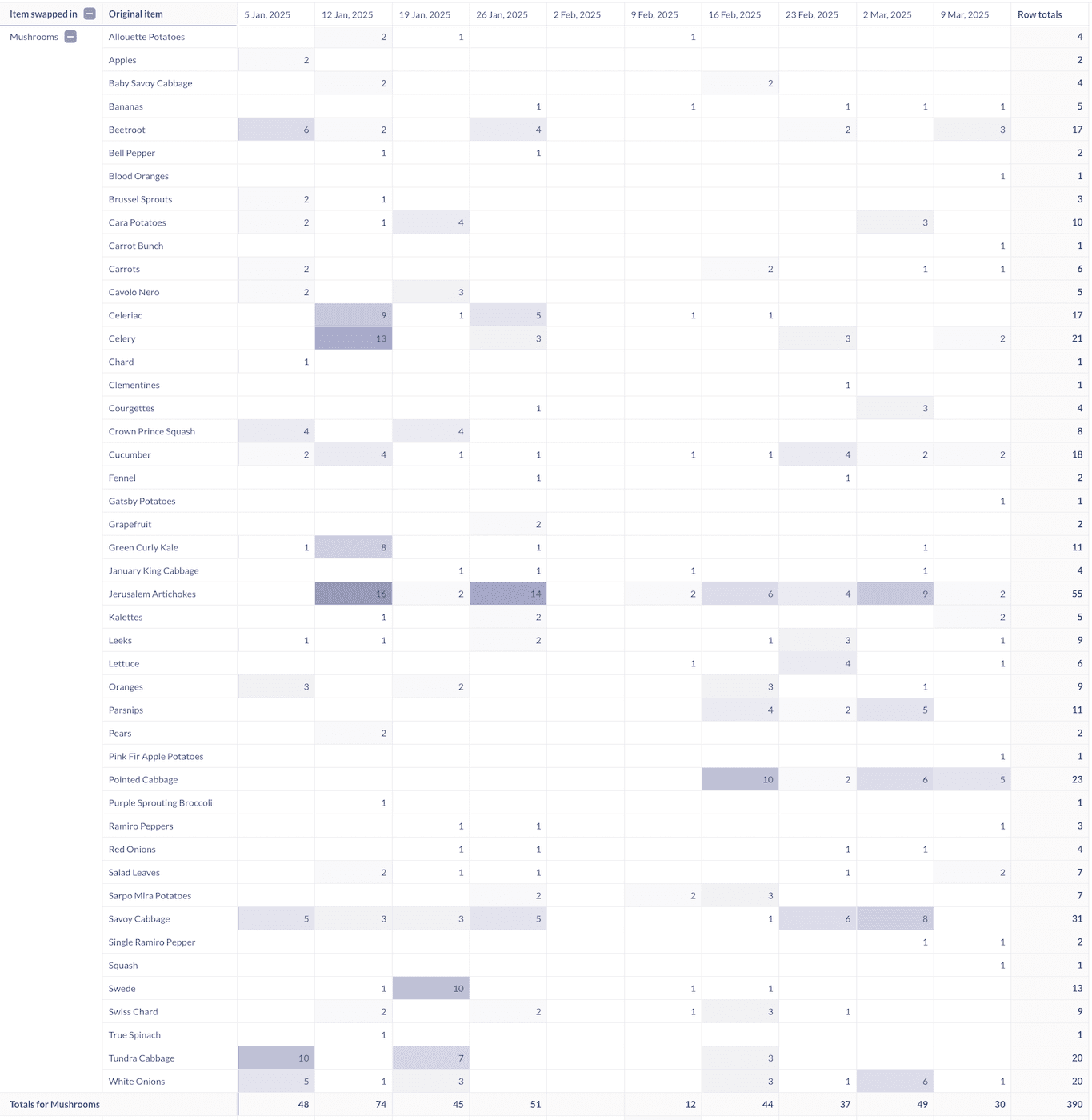
What are mushrooms swapped IN to replace?
By biggest volume;
- x55 Jerusalem artichokes
- x31 savoy cabbage
- x23 pointed cabbage
- x21 celery
- x20 tundra cabbage, white onions
This data will help us build a picture of specific swaps that are made - are there some items that are likely swap-companions? We will investigate!
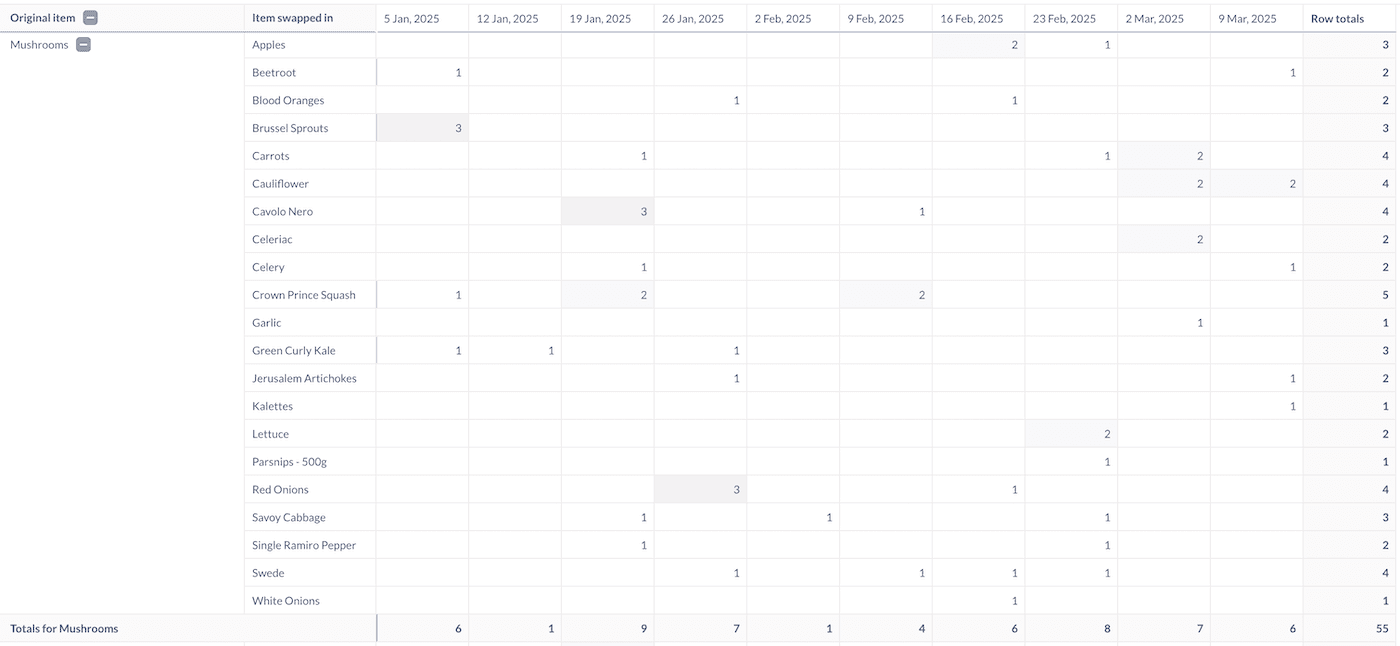
What are mushrooms replaced by when swapped OUT?
No obvious pattern.
That’s it for now. I’ll look forward to reporting back with the findings of our next round of investigation. In the meantime, if you’d like to have a chat to me about any of the above please do get in touch.
If you’re reading and sell veg boxes but not yet a user of our veg box operating system, we’d love to show you around.
Steve